Before You Say Yes: A Calm Checklist for 2026 Bridal Appointments
Photo: FOTO:Fortepan — ID 13: Adományozó/Donor: Fortepan., CC BY-SA 3.0, via Wikimedia Commons
There is a particular kind of chaos that happens in a bridal fitting room, and it is almost never about the dresses. It's about the bag you didn't pack, the friend who came along for the prosecco, and the fact that nobody told you the samples would be three sizes off and held together at the back with clips. A good appointment isn't luck. It's preparation, a bit of manners and a list of questions you actually ask out loud.
Start with the diary, not the dress
Before you book anything, look at the year honestly. Most designers work on a six-to-nine month production timeline, and alterations sit on top of that. If you're marrying in autumn 2026 and it's already November, you're in ready-to-wear, sample-sale or off-the-peg territory — which is a perfectly good place to be, as long as you know it before you fall for a gown with a fourteen-week lead time.
Book no more than two boutiques in a single day, and give each one 90 minutes of breathing room. Three appointments in an afternoon sounds efficient and feels like a car wash by the third rail.
What to wear to try on wedding dresses
This is the bit people skip, and it's the bit that changes how you see yourself in the mirror.
- Underwear you'd be happy to be seen in. Nude or soft-tone seamless knickers, and a bra that matches the neckline you're curious about. If you want to try strapless, bring a strapless bra — or accept that you'll be trying the dress bra-less, which many boutiques expect and none will make awkward.
- Something with sleeves or a wrap. Fitting rooms run hot, corridors run cold.
- No fresh fake tan. It transfers onto ivory duchesse satin and the boutique will not thank you.
- Light make-up, hair tie on your wrist. You want to see your neck and shoulders at least once without your hair down.
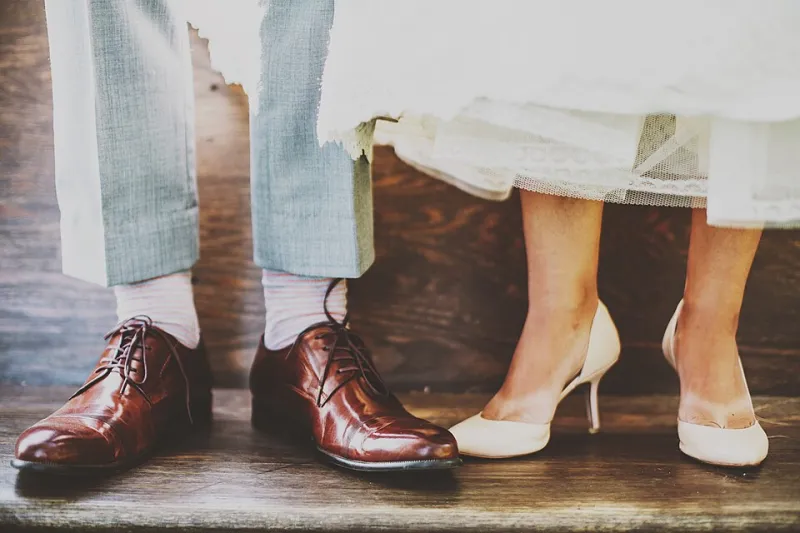
- Shoes at roughly your wedding heel height. Even a pair of old heels at the right height tells you whether a hem will work.
The bag: small, boring, genuinely useful
Pack the following and you'll be the calm one in the room:
- Your shoes, or shoes of the same height.
- A bottle of water and something to eat — appointments run long and low blood sugar makes every dress look wrong.
- Photos of the venue, two or three maximum, plus a fabric swatch if you have one.
- A notebook. Notes taken on your phone get lost under 200 photos of your own back.
- A tape measure, if you're between sizes and want to talk numbers sensibly.
- Your own strapless bra and a pair of hold-ups or tights if you're trying on something sheer.
Leave the giant tote at home. Fitting rooms are small and the assistant has to step around your luggage.
Sample sizes: the UK rail reality
Most UK boutiques carry samples in a size 10 to 14. If you're a size 6 or a size 22, expect clips, pins and a certain amount of creative draping. This is normal and it is not a verdict on your body or the dress.
Ask two clear questions: what size would I order, and how does that compare to the sample I'm standing in? Designers' sizing varies wildly, and a 12 in one house is a 16 in another. You are not buying a number, you're buying a garment that will be altered to you.
Bring fewer people than you think
Two guests is plenty for a first appointment. One is better. A group of five produces a committee, and committees design by compromise — which is how people end up in a dress that pleases everyone except the person wearing it.
If your mum is going to cry and your best friend is going to give a forensic opinion, consider bringing one of them first and the other to the second appointment. Or go alone. Plenty of brides book a solo hour specifically to find out what they actually like before inviting anyone to comment.
The questions to ask before you say yes
Write these down. Ask them at the point the assistant says "so, how are we feeling?"
- What is the production lead time, and what's the latest order date for my wedding?
- Are alterations done in-house or by an independent seamstress, and what do they typically cost? Three fittings is normal; budget 10–15% of the gown price.
- Does the quoted price include VAT, and is it the same for an order as for the sample?
- What's the deposit, is it refundable, and what happens if I change my mind?
- Can I photograph myself in the dress? Some designers say no, and it's kinder to ask than to be caught.
- What does the dress need on the day — steaming, pressing, a hook added?
- Is there a rush fee, and how much?
Boutique etiquette, briefly
Arrive on time, don't bring more guests than agreed, and don't ask to try on a gown that is two price brackets above your budget. Say no politely and specifically: "not this one, but I loved the neckline" gets you further than a silent shake of the head.
And remember the phrase "I'd like to think about it" exists for a reason. Deposits are rarely refundable, and the pressure to have a Moment is a sales technique, not a deadline.
You are allowed to leave empty-handed
A first appointment that ends with no decision is not a failure — it's information. You now know which silhouettes made you stand taller, which fabrics made you itch, and which shop's lighting you'd trust with your wedding photos. Take the notes home, sleep on it, and book the second one with a plan. That's how you say yes to the right dress rather than the loudest room.