Step Into the Daylight: Judging a Wedding Dress Beyond the Boutique Mirror
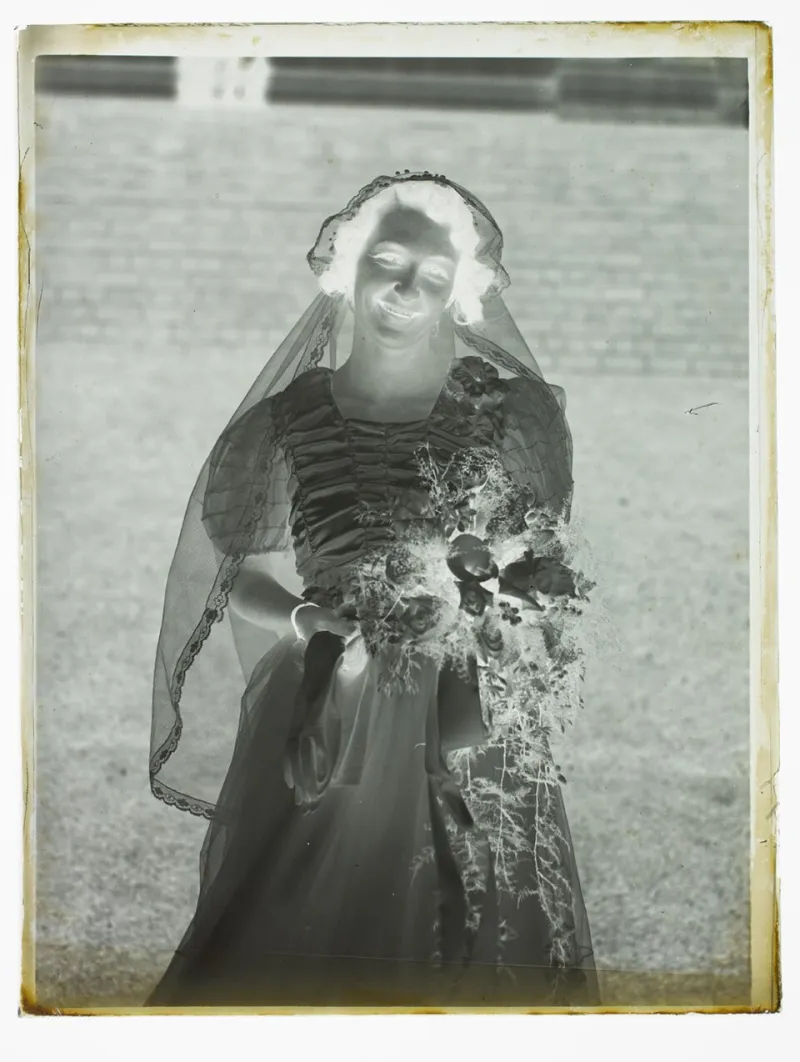
Photo: Collins, Tudor Washington, 1898-1970, photographer, CC BY 4.0, via Wikimedia Commons
There is a particular kind of lighting in bridal boutiques that makes almost everything look like the dress. Warm bulbs, a dimmer switch, mirrors angled a touch forward, soft carpet underfoot, a little pedestal to stand on. It's not deception, exactly — it's staging. And staging is brilliant until you're standing at the back of a marquee in July, under a white canopy, in the flattest light England can produce.
The gap between the salon and the venue is where dress regret lives. Here's how to close it before you sign anything.
Why salon light flatters so effectively
Most fitting rooms run on warm, low-level lighting — think 2700K, the colour of a lamp in a living room. Warm light softens texture, makes ivory read creamier than it is, and coaxes a glow out of beading that you won't see again until the disco. The mirror is usually tilted just slightly, which lengthens the silhouette. The floor is carpeted, so the skirt pools softly rather than catching on anything.
Daylight, by contrast, sits somewhere around 5000–6500K. It's cooler, flatter and far less forgiving. Seams show. Lace looks like lace rather than a watercolour. A white that looked softly bridal under a spotlight can read faintly blue by a window. None of this means the dress is wrong — only that you haven't met it yet.
The window test
Ask, plainly, whether you can stand near a window for a minute or two. Any boutique worth your deposit will say yes. Take the dress into natural light, ideally indirect rather than direct sun, and look at it at three distances: close enough to inspect the stitching, arm's length for how it drapes, and about three metres away — the guest view. That three-metre look is the one most brides never do, and it's the one your photographs will repeat all day.
If the shop has no windows, ask them to raise the lights to their brightest, coolest setting. Some boutiques keep a daylight bulb or a portable lamp for exactly this. If they won't, note it.
The phone-photo reality check
Take photographs — with the flash off, then with it on. Take a short video of you walking away and turning back. Then look at the images on your own phone, at normal brightness, not on the salon's tablet with the settings cranked up. Turn off any beauty filter, portrait mode or auto-enhancement first; a few of them quietly reshape a shoulder line and you'll never match it in real life.
One more useful trick: photograph the dress beside something you know is white — a sheet of printer paper, a plain white shirt, a cotton napkin. It tells you immediately whether you're looking at ivory, champagne or something closer to true white.
Sit down. Properly.
Ask for ten minutes in a chair, ideally one similar in height to what you'll sit on at the venue — a dining chair rather than a low sofa. Boning that felt supportive standing up can dig in the ribs when you're seated. Waistbands ride up. Cups gape. Skirts collapse into a puddle that looks nothing like the lovely pooling you saw in the mirror. Ten minutes on a chair is worth an hour of pedestal posing.
Walk, turn, climb, hug
Twenty paces across the room. A turn. A flight of stairs if the shop has them — many venues and most registries do. Try the dance-floor question: can you raise your arms above your head? Can you hug someone without them standing on tulle? Can you reach for a glass on a table?
And yes, ask about the toilet. Every honest bridal stylist has this conversation eventually. A ballgown with sixteen layers is a two-person operation; if that's a dealbreaker, better to know now than at 9pm on the day.
Check the colour against you, not just the hanger
Bring the friend who tells the truth. Stand in the daylight, look at your face rather than the dress, and ask whether the fabric is doing anything unkind to your skin tone. If your partner is planning a particular suit or shirt, bring a photo. If your bridesmaids are in a set colour, bring the swatch. Bridal whites are wonderfully uncooperative next to each other, and it's far easier to adjust the accessories than the gown.
The alterations conversation
This is where most of the surprises hide, so ask directly and write the answers down:
- What exactly is included in the price, and what is charged separately?
- Who does the alterations — in-house, or an external seamstress?
- Can I have that quote in writing, before I pay the deposit?
- How many fittings are typical, and how long does the whole process take?
- What does a hem cost? A take-in at the waist? A bustle?
- How many sizes can this dress realistically be taken in — and can it be let out at all?
- Is the sample I'm wearing the same size I'd be ordering, and is the fabric the same dye lot?
- What happens if my weight shifts by a stone in either direction?
- When is the final fitting relative to my wedding date, and what's the buffer?
A dress that can only come down one size is a dress with a very narrow margin for error. That's not a reason to walk away — it's a reason to order at the right time.
Small red flags worth noticing
No photography allowed. A discount that expires today. Alterations brushed off as 'we'll make it work'. No written quote. A sample that's three sizes off being described as 'easily taken in'. Any one of these might be nothing; two or three together is a pattern.
What to bring
Nude or pale underwear, the shoes or at least the heel height, a hairband so you can see your neckline properly, water, a notebook and one blunt friend. Leave the entourage at home for the first appointment — five opinions in a small room is not a decision-making environment.
Then sleep on it
Look at your photos the next morning, on a bigger screen, in daylight, with a cup of tea. Not at 11pm on a phone in bed, when everything is either the most beautiful dress you've ever seen or a disaster. The dress should still make sense in the morning, in ordinary light, with your ordinary face on. That's the version of you who'll be wearing it.